The Four Turandot · T4T · 2026
Four endings
Puccini died before finishing Turandot. The opera has four endings, and T4T staged one in each city. Pull the thread of Act Three: at Liù’s death you can stop, as Toscanini did in 1926, or choose an ending.
Pull the thread, or choose a city.
Drag the thread with your finger or the mouse. From the keyboard: arrow keys and Enter, or the four buttons below.
In the background, our render of the Miller Theater in Augusta.
The project in brief
Puccini beyond the centenary
The Four Turandot is an advanced artistic training project born around the centenary of Turandot: the world première was conducted by Arturo Toscanini at La Scala on 25 April 1926. Between February and April 2026 the opera was staged in four theatres, in Italy, the United States, South Korea and China, each time with a different ending. The closing concert, on 8 May in Milan, set the three endings side by side.
The lead institution is the “Giuseppe Verdi” Conservatory of Milan. The partners are the Conservatories of Florence, Modena and Carpi, Piacenza and Turin, the Politecnico delle Arti of Bergamo, the University of Milan and NABA, Nuova Accademia di Belle Arti. Casa Ricordi and the Archivio Storico Ricordi have joined the project. Abroad, the performances were hosted by the Miller Theater in Augusta, Keimyung University in Daegu and the Zhejiang Conservatory of Music in Hangzhou.
GR STUDIO works for the “Giuseppe Nicolini” Conservatory of Piacenza, one of the partners: on its behalf, GR STUDIO is the project’s scientific lead.
The official project website: t4t.consmi.it
Project funded by the European Union, NextGenerationEU, within Italy’s recovery plan (PNRR).
The four stages
Four theatres, four endings
The cast was double, so each city had two performances: in Augusta on the same day, 7 February. Each city had its own ending. Dates and venues link to the news items on the official website.
Augusta Georgia, United States
Miller Theater
The version interrupted at Liù’s death, as at the 1926 première.
The official news itemMilan Italy
Sala Verdi, Conservatorio di Milano
Luciano Berio’s ending (2001).
The official news itemDaegu South Korea
Keimyung Art Center
Franco Alfano’s second ending.
The official news itemHangzhou China
Zhejiang Conservatory of Music
Franco Alfano’s first ending.
The official news itemClosing concert “Puccini oltre il centenario”
Milan, Sala Verdi, Conservatorio di Milano
Alfano’s two endings and Berio’s, one after the other, on the same evening.
The official news item
The four endings, in brief
Puccini died on 29 November 1924. He had written and orchestrated the opera up to Liù’s death and left 36 pages of sketches for the rest. Franco Alfano completed the ending from those sketches: a first, longer version, then a second, shorter one, which is the one that entered the repertoire. At the première, on 25 April 1926, Toscanini stopped the performance at Liù’s death; from the second performance Alfano’s ending was played. In 2001 Luciano Berio wrote a new ending from the same sketches.
Our work
What we brought home
From each performance we collected four things, to reconstruct the opera in a virtual environment that can also be walked through with a headset.
Sound in space
Ambisonics recordings, which keep the position of the orchestra and of the performers as they move.
The acoustic signature of the theatre
The impulse responses of each hall, to make the virtual theatre sound like the real one.
Gesture
The performers’ movements, captured with an infrared OptiTrack system and with 360° cameras.
Faces and costumes
Scans of the performers of both casts, in make-up and stage costume.
A tour begins with the technical rider: what the host theatre needs, what we bring, how two technical crews that do not share a language talk to each other.
The eight duties of the assignment
The “Giuseppe Nicolini” Conservatory of Piacenza entrusted GR STUDIO with the scientific responsibility for the project. The assignment is divided into eight duties.
- Project direction
- Software programming
- 3D scanning of the spaces
- Modelling of halls and faces
- Acoustic sampling of the spaces
- Coordination of the live events
- Production coordination
- Research and tests with the partners
The theatre in 3D
The Miller Theater, rebuilt
After China the work moved to the laboratories of XNL Musica and of the Conservatory, in Piacenza. The theatres are reconstructed in three dimensions, stalls, gallery, proscenium and fly grid, and the performers return to the stage as digital characters. The first is the Miller Theater in Augusta.


“Nessun dorma”
A 90-second demonstration video: Calaf, the stage and the hall are entirely reconstructed in Unreal Engine 5. Calaf is a MetaHuman animated with the motion capture data recorded during the performance; the lip sync comes from the vocal track and the costume is simulated as fabric, in real time.
Crossing sound
The hall’s real acoustics, on headphones
Alongside the virtual reality platform we are writing a second piece of software: an audio renderer that takes the impulse responses measured in the theatres and applies them to the virtual environments. The voice is produced by convolution with the hall’s ambisonic impulse responses, the ARIRs, which describe how it reflects off the walls, the stage and the stalls. On headphones it becomes binaural, and it changes with the listener’s position and orientation.
The graphics engine sends it the listener’s position up to 60 times per second. The renderer drives the scene time, and on that time animation, lip sync and voice stay together.
On 25 September 2026, at the European Researchers’ Night in the former Carmine church in Piacenza, we let people try it: with a joystick and a pair of headphones you could walk through the stalls of the Miller Theater while Calaf sings “Nessun dorma”, with the hall’s real acoustics. One person at a time, from 8:30 to 14:00, aged fifteen and over.


Where it comes from
From Georgia to Piacenza
The method predates T4T. On 6 February 2023 Gianmarco Romiti left for Athens, Georgia, on an Erasmus project: to rebuild the rooms of the University of Georgia’s Dancz Center, not only how they looked but how they sounded. More than nine thousand photographs in two months, rooms explorable with a headset in Blender and Unreal Engine 5, tests of binaural and ambisonic sound.
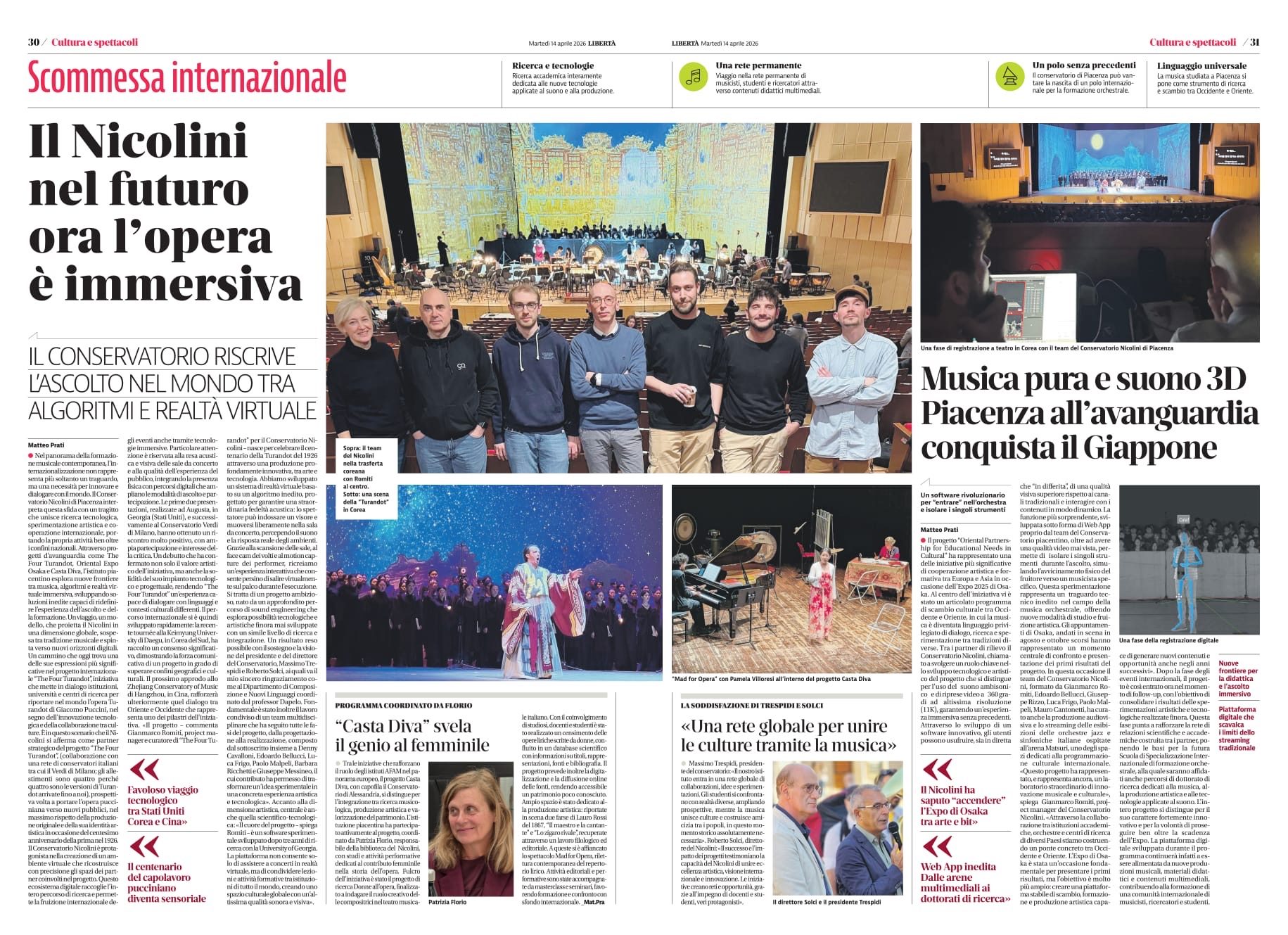
From October 2023 the work moved on to people: face scanning and motion capture of the body, facial expressions and hands, to bring a performing artist into virtual reality together with their music. In November 2024 the Milan and Piacenza delegation visited Athens, and the University of Georgia became a research partner on the software; within the partnership Gianmarco Romiti holds the title of International Collaborator at the university. As he told Libertà on 14 April 2026, the heart of the project is “an experimental software developed after three years of research with the University of Georgia”. In May 2026 the leadership of the Dancz Center came to Piacenza for days of joint review, on method and on code.
Credits and links
To find out more
This is not the project’s official website. It is a GR STUDIO SRL website about the work carried out for the “Giuseppe Nicolini” Conservatory of Piacenza, a partner of The Four Turandot. The photographs of the performances are on the official website: here we link to the news items, without copying them.
The project
Our account
Funding
THE FOUR TURANDOT – T4T, INTAFAM_00048, CUP F41I23000550001, PNRR Missione 4 Componente 1 Investimento 3.4, NextGenerationEU